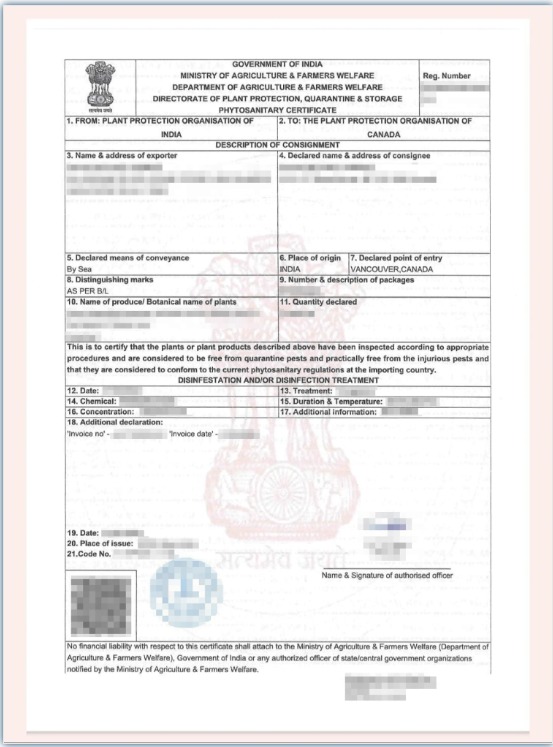



Phytosanitary Certificate Online in India

Phytosanitary keeps track of plants and plant products before they are sent from one site to another. This helps keep them safe. It keeps the plants from spreading diseases or pests that could harm trees, fields, or other plants.

If you want to bring plants, vegetables, seeds, or flowers into or out of the country, you need to secure a Phytosanitary Certificate from the government. This paper says that your plants are healthy and can go on the vacation. It is an important part of international agricultural trade and helps protect the crops and environment of importing countries from harmful organisms.

Phytosanitary Registration plays a vital role in global agricultural trade. It ensures that only safe and pest-free plants and products cross borders. By following phytosanitary standards, India and other countries can protect their crops, support farmers, and promote sustainable trade.

It is not just a legal requirement but also an important responsibility towards food security and environmental safety.

Key Topic Index

  • What is the purpose of Phytosanitary Certificate ?
  • Who Needs a Phytosanitary Certificate ?
  • What documents required for Phytosanitary Certificate?
  • How Make Merchant helps you to get Phytosanitary Certificate?
  • How to get Phytosanitary Certificate in India ?
  • Frequently Asked Questions (FAQ's)
  • When you want to launch your business, Make Merchant is where it's at!
table content image

What is the purpose of Phytosanitary Certificate ?

  • To protect farms and wild plants against pests and illnesses that could hurt them.
  • To obey the laws of the places where you send the plants.
  • To help customs agents check your items and get them out of the way faster.
  • To make sure that your belongings don't get stuck or turned away at the border.
  • To make sure that consumers can believe in your business.

Who Needs a Phytosanitary Certificate ?

A Phytosanitary Certificate is usually required by:

  • Exporters sending plants, agricultural products, or plant-based goods to other countries.
  • Businesses and traders dealing in products like fruits, vegetables, seeds, grains, spices, and herbs.
  • Suppliers or manufacturers exporting nursery plants, timber, wooden items, or packaging materials.
  • Merchants whose products must meet the plant quarantine rules of the importing country.
  • Anyone involved in exporting goods that may be checked for pests, diseases, or contamination before shipment.

What documents required for Phytosanitary Certificate?

  • Business Registration Proof like the GST Certificate.
  • Import -Export Certificate (IEC)
  • Email Id of authorised signatory
  • Contact Number of authorised signatory
  • Packing list for the subject shipment
  • Invoice for the subject shipment

How Make Merchant helps you to get Phytosanitary Certificate?

  • We teach you how to get all the paperwork you need for your goods.
  • We assist you fill out the application and send it in the appropriate way.
  • We work with the personnel in charge of quarantining plants to speed up the process of getting checks and approvals.
  • We keep an eye on your application until you acquire the certificate. This makes the whole thing simple and stress-free.

How to get Phytosanitary Certificate in India ?

To obtain a Phytosanitary Certificate, exporters must follow a defined process that ensures plant products comply with international plant health regulations.

  • Step 1: Understand Requirements: Check with the National Plant Protection Organization (NPPO) or the Directorate of Plant Protection, Quarantine, and Storage, or visit the Plant Quarantine Information System (PQIS) portal to understand the phytosanitary requirements applicable to your product.

  • Step 2: Prepare Documentation: A Phytosanitary Certificate is obtained by submitting essential documents such as the application form, invoice, packing list, and any required permits. These documents enable inspection of the consignment and confirm compliance with phytosanitary norms.

  • Step 3: Application Submission: Complete the application form and submit it to the concerned Plant Quarantine authority. Attach all required documents and pay the applicable inspection fee.

  • Step 4: Inspection Process: Your consignment will be examined by an authorized officer at your premises or the designated Plant Quarantine Station. Inspection may include sampling, testing, or treatment, if required.

  • Step 5: Issuance of Phytosanitary Certificate: The certificate will be issued if the consignment is accepted after inspection. It includes key shipment and compliance details as per import requirements.

  • Frequently Asked Questions (FAQ's)

    Phytosanitary registration checks that plants, seeds, flowers, and other plant products are free of pests and illnesses before they can be carried into or out of a country.

    Anyone who brings in or sends out plant-based items including seeds, fruits, vegetables, flowers, or timber needs to register.

    This stops pests and illnesses from spreading through plants that are brought in or sent out, which helps safeguard the environment and local farming.

    It can take anywhere from 30 to 90 days, but it all depends on the check and the documentation.

    Proof of business, such as a PAN, GST, or IEC, invoices, product information, packing information, treatment certificates, and quarantine inspection records are all things that are usually preserved as proof.

    When you want to launch your business, Make Merchant is where it's at!

    Make Merchant provides the lowest prices in India and simplifies the process of registering your business. Get in touch with us immediately for a no-cost consultation and assistance with the entire process.

    logo

    We are a one-stop solution for businesses that wish to grow and move from local to global

    Contact Info

    Office Address

    Address: 308, 3rd floor, bheema complex, nirman vihar , east delhi, delhi 110092