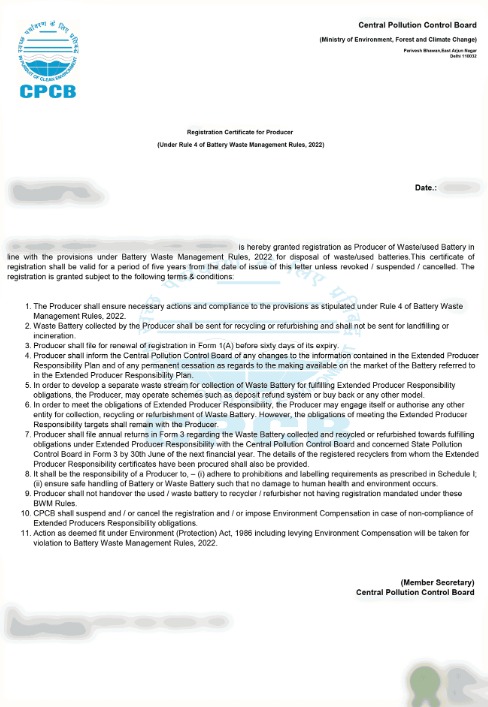





EPR registration for Battery Waste Management

If your company deals with batteries in India — whether as a manufacturer, importer, brand owner, assembler, or recycler — obtaining EPR Battery Registration is a mandatory obligation. This registration is issued by the Central Pollution Control Board to ensure that businesses take responsibility for the collection, recycling, and environmentally safe disposal of battery waste generated from their products.

Batteries contain hazardous substances such as heavy metals, lithium compounds, acids, and other chemical residues. If these materials are not disposed of properly, they can cause serious harm to the environment and human health. To tackle this issue, the Indian government introduced the Battery Waste Management Rules, 2022, which makes it compulsory for businesses placing batteries in the Indian market to manage their end-of-life waste responsibly.

The rules apply to all battery categories, including EV batteries, portable batteries, UPS batteries, and industrial batteries. Businesses are required to establish proper recycling systems, monitor battery returns, and submit annual EPR compliance reports to the authorities to maintain regulatory compliance and avoid penalties.

If your company deals with batteries in India — whether as a manufacturer, importer, brand owner, assembler, or recycler — obtaining EPR Battery Registration is a mandatory requirement. This registration is issued by the Central Pollution Control Board to ensure that businesses take responsibility for the collection, recycling, and environmentally safe disposal of battery waste generated from their products.

Batteries contain harmful materials such as heavy metals, lithium compounds, acids, and other chemical residues. If these substances are not handled properly, they can lead to serious environmental damage and health risks. To address this concern, the Indian government introduced the Battery Waste Management Rules, 2022, making it mandatory for businesses placing batteries in the Indian market to manage their end-of-life waste responsibly.

The rules apply to all battery categories, including EV batteries, portable batteries, UPS batteries, and industrial batteries. Businesses must implement proper recycling mechanisms, track battery returns, and submit annual EPR compliance reports to the authorities to ensure compliance and avoid penalties.

Key Topic Index

  • EPR registration for Battery Waste Management
  • What is EPR Battery Waste Registration?
  • Who needs EPR battery waste registration?
  • Why is EPR Battery Registration Important?
  • How Does Make Merchant Help You?
  • EPR Battery Waste Registration Process
  • What documents are required for EPR Battery registration?
  • Frequently Asked Questions
  • Why should you partner with Make Merchant?
table content image

What is EPR Battery Waste Registration?

EEPR Battery Waste Registration is a mandatory authorization for businesses that manufacture, import, sell, or distribute batteries in India. It ensures that companies take responsibility for the collection, recycling, and environmentally sound disposal of used batteries generated from their products. This requirement is implemented under the Battery Waste Management Rules, 2022 and regulated by the Central Pollution Control Board to minimize the environmental impact of battery waste.

Through EPR registration, businesses are required to meet specified recycling targets, set up proper waste management systems, and submit annual compliance reports to CPCB. The registration is granted through the official CPCB EPR Battery Portal, and companies must obtain it before introducing batteries into the Indian market.

This framework ensures that battery producers actively contribute to responsible recycling and sustainable waste management practices in India.

Who needs EPR battery waste registration?

EPR Battery Registration is required for any business that introduces batteries into the Indian market. Under the Battery Waste Management Rules, 2022, companies are expected to take responsibility for the collection, recycling, and safe disposal of battery waste generated from their products. This regulation is implemented and monitored by the Central Pollution Control Board.

In simple terms, if your business is putting batteries into the market, you are also responsible for managing what happens to them after they are used.

Here are the types of businesses that usually require EPR Battery Registration:

  • Battery manufacturers producing batteries in India
  • Importers bringing batteries or battery cells into the country
  • EV manufacturers using lithium-ion batteries in electric vehicles
  • Inverter and UPS battery brands selling backup power batteries
  • OEMs using lithium cells in electronic devices and equipment
  • Lead-acid battery manufacturers and suppliers Battery assembly units and distributors involved in the supply chain
  • Companies selling electronic products with in-built batteries

If your business is involved at any stage—whether placing batteries in the market or generating battery waste through your operations—you are legally required to ensure proper collection and recycling through authorized recyclers.

Why is EPR Battery Registration Important?

EPR Battery Registration is important because it makes businesses accountable for the entire lifecycle of the batteries they introduce into the market—not just selling them, but also managing the waste they create later.

Under the Battery Waste Management Rules, 2022, regulated by the Central Pollution Control Board, this responsibility is legally enforced to protect both the environment and public health.

Here’s why it really matters:

  • 1. Protects the Environment 🌱

    Batteries contain harmful substances like lithium, lead, and acids. If not disposed of properly, they can pollute soil, water, and air. EPR ensures safe recycling and disposal.

  • 2. Legal Compliance 📜
  • Without EPR registration, your business is not legally allowed to operate in the battery segment. Non-compliance can lead to heavy penalties, fines, or even business restrictions.

    • 3. Promotes Responsible Business Practices ♻️

      It ensures that companies don’t just sell products but also take responsibility for the waste they generate—building a more sustainable business model.
    • 4. Builds Brand Trust 🤝

      Customers and partners prefer businesses that follow environmental norms. EPR compliance shows that your company cares about sustainability and responsibility.

    • 5. Supports Recycling Ecosystem 🔄

      It encourages proper collection systems and partnerships with authorized recyclers, helping India move towards a circular economy.

    • 6. Mandatory for Market Entry 🚫

      If you want to manufacture, import, or sell batteries in India, EPR registration is not optional—it’s a must-have before entering the market.

    How Does Make Merchant Help You?

    Navigating EPR regulations can be complex, but Make Merchant makes it simple:

    • Complete Registration Assistance: From application to approval with the Central Pollution Control Board (CPCB).
    • Documentation & Filing Help: We prepare required documents and action plans outlining how battery waste will be managed.
    • Tracking & Reporting: We help you monitor collection and recycling targets and submit compliance reports on time.
    • Certification & Renewal: Assistance in obtaining and renewing your EPR certificates without delays.
    • Ongoing Support: Expert advice to stay updated with rule amendments and avoid penalties.

    Trust Make Merchant to take the compliance burden off your hands so you can focus on growing your business.

    EPR Battery Waste Registration Process

    1. Register on CPCB's EPR Portal
      All producers must create an account and fill out the online application form.
    2. Submit a Battery Waste Management Plan.
      Provide detailed procedures for collecting, refurbishing, and recycling used batteries.
    3. Collaborate with Recyclers or Refurbishers
      Partner with authorized entities to handle your battery waste responsibly.
    4. Achieve Recycling Targets
      Meet the annual collection and recycling targets established by government regulations.
    5. Receive EPR Certificates
      CPCB issues certificates based on the weight of batteries recycled/refurbished by recyclers.
    6. File Annual Compliance Reports
      Submit timely reports confirming target achievement.
    7. Renew Authorization Before Expiry
      EPR certificates need periodic renewal for continuous compliance.

    What documents are required for EPR Battery registration?

    To obtain EPR Battery Registration under the Battery Waste Management Rules, 2022, you need to keep a set of important documents ready. These documents help the Central Pollution Control Board verify your business details and ensure proper compliance.

    • GST Certificate
    • CIN / Incorporation Certificate
    • IEC (Import Export Code) – required if you are importing batteries
    • PAN of the entity
    • HSN details of batteries placed in the market
    • BIS Certification (if applicable)
    • Product description along with model details
    • Recycling arrangement agreement
    • Proof of tie-up with an authorized recycler
    • Return collection plan for battery waste
    • Annual production or import data
    • Valid environmental compliance authorization
    • In simple terms, these documents prove that your business is genuine, compliant, and has a proper system in place for collection and recycling of battery waste.

    Frequently Asked Questions

    All automotive, lithium-ion, industrial, and portable batteries that are sold or imported in India require EPR registration.

    Non-compliance may result in substantial fines, suspension or cancellation of registration, and possible legal action.

    Typically, it takes 30 to 45 days to obtain EPR authorization, provided that the applications and documents are complete.

    EPR certificates are non-transferable and are linked to the compliance performance of the holder.

    Yes, importers are also required to comply with the EPR regulations and obtain EPR authorization.

    Why should you partner with Make Merchant?

    • Experience: We have years of successful EPR registrations and renewals.
    • Expert Team: Our qualified consultants are here to guide you.
    • Transparency: We offer clear pricing with no hidden fees.
    • Customer Care: Expect prompt responses and tailored solutions.
    • Sustainability Focus: We help businesses contribute to a greener India.

    Are you ready to secure your EPR Authorization for battery waste management? Contact Make Merchant today to begin your journey with expert guidance and smooth compliance.

    When you want to launch your business, Make Merchant is where it's at!

    Make Merchant provides the lowest prices in India and simplifies the process of registering your business. Get in touch with us immediately for a no-cost consultation and assistance with the entire process.

    logo

    We are a one-stop solution for businesses that wish to grow and move from local to global

    Contact Info

    Office Address

    Address: 308, 3rd floor, bheema complex, nirman vihar , east delhi, delhi 110092